



Artificial intelligence (AI) is no longer a future concept in manufacturing—it is already reshaping how factories operate, compete, and scale. What began as basic automation and rule-based systems has evolved into intelligent, data-driven capabilities that can predict failures, optimize production, and continuously improve performance. Today, AI in manufacturing is a core pillar of smart factories and Industry 4.0 initiatives worldwide.
At Havi Technology, we work closely with manufacturers at different stages of digital maturity, from early experimentation with AI to full-scale deployment across production, quality, and supply chain operations. This guide explains what AI in manufacturing really means, the technologies behind it, how it is used in real factories, the benefits it delivers, and how organizations can implement AI successfully and responsibly.
AI in manufacturing refers to the application of artificial intelligence technologies - such as machine learning, computer vision, natural language processing, and optimization algorithms - to industrial processes and operations. Unlike traditional automation, which follows predefined rules, AI systems learn from data, adapt to changing conditions, and improve outcomes over time.
In practical terms, AI enables manufacturing systems to:
Traditional manufacturing automation focuses on repeatability and consistency. AI-driven manufacturing adds intelligence and adaptability.
Key differences include:
This shift is what enables smart factories—facilities that can self-monitor, self-optimize, and respond dynamically to internal and external changes.
Machine learning (ML) is the foundation of most AI in manufacturing applications. ML models analyze historical and real-time data to identify patterns and make predictions. Deep learning, a subset of ML, uses neural networks to handle complex data such as images, audio, and sensor streams.
In manufacturing, ML is used for:
Computer vision enables machines to “see” and interpret visual information from cameras and sensors. Using deep learning models, computer vision systems can detect defects, measure dimensions, and verify assembly accuracy at speeds and precision levels beyond human capability.
This technology is especially valuable in:
NLP allows AI systems to understand and generate human language. While less visible on the factory floor, NLP plays an important role in manufacturing by enabling:
Optimization algorithms use AI to evaluate millions of possible scenarios and identify the best course of action based on defined objectives and constraints. In manufacturing, this is applied to:
Smart factories generate massive volumes of data from machines, sensors, and control systems. Edge AI processes this data close to where it is generated, reducing latency and enabling real-time decision-making.
When combined with Industrial IoT (IIoT), edge AI allows manufacturers to:
Predictive maintenance is one of the most widely adopted AI use cases in manufacturing. By analyzing sensor data such as vibration, temperature, and pressure, AI models can predict equipment failures before they occur.
Benefits include:
At Havi Technology, predictive maintenance often delivers some of the fastest ROI because it leverages existing machine data and addresses a clear operational pain point.
AI-powered quality inspection systems use computer vision to detect defects in real time. These systems can inspect 100% of products without slowing down production, improving consistency and reducing waste.
Common applications include:
AI enhances production planning by analyzing demand forecasts, resource availability, and production constraints simultaneously. Unlike static planning tools, AI-driven systems can adapt plans dynamically as conditions change.
This results in:
AI models continuously analyze production data to identify inefficiencies and recommend adjustments. Over time, these systems learn which process parameters produce the best outcomes.
Examples include:
AI in manufacturing extends beyond the factory floor into supply chain operations. By analyzing supplier performance, demand variability, and logistics data, AI helps manufacturers:
AI-powered robots can perform tasks that require perception, learning, and adaptation. Collaborative robots (cobots) work alongside humans, enhancing productivity while maintaining safety.
Applications include:
AI automates complex decision-making processes, enabling faster and more accurate operations. This leads to higher throughput, reduced waste, and improved overall equipment effectiveness (OEE).
By detecting defects and process deviations early, AI reduces variability and ensures consistent product quality. This is critical for industries with strict regulatory or customer requirements.
AI reduces costs by minimizing downtime, optimizing energy usage, and improving resource utilization. Over time, these savings can significantly impact profitability.
Rather than replacing workers, AI augments human capabilities. Operators and engineers can focus on higher-value tasks while AI handles data analysis and routine monitoring.
AI provides actionable insights in real time, enabling managers to make informed decisions quickly. This is especially important in dynamic manufacturing environments.
Successful AI initiatives start with well-defined goals. Rather than deploying AI for its own sake, manufacturers should identify specific problems to solve, such as reducing downtime or improving yield.
AI systems depend on high-quality data. Manufacturers must evaluate:
Based on experience at Havi Technology, data readiness is often the biggest determinant of AI success.
Pilot projects should focus on areas with clear value and manageable complexity. Early wins help build organizational confidence and support.
AI solutions must integrate with MES, ERP, SCADA, and other manufacturing systems. Seamless integration ensures insights translate into action.
Once pilots succeed, AI should be scaled across processes and sites. This requires governance, standardized architectures, and continuous monitoring.
Poor data quality can undermine AI models and lead to inaccurate predictions. Manufacturers must invest in data governance and infrastructure.
Legacy systems and heterogeneous equipment can complicate AI integration. Careful system architecture planning is essential.
AI adoption requires new skills and cultural shifts. Employees must be trained to trust and work with AI-driven systems.
As manufacturing becomes more connected, cybersecurity risks increase. AI systems must be designed with robust security measures.
Manufacturers must ensure transparency, fairness, and accountability in AI decision-making, especially when AI influences safety or workforce decisions.
Smart factories represent the convergence of AI, IoT, automation, and advanced analytics. In these environments, AI acts as the intelligence layer that connects data, systems, and people.
Key characteristics include:
AI in manufacturing is not a standalone technology—it is an enabler of the broader smart factory vision.
Manufacturers are moving beyond experimentation toward enterprise-wide AI adoption.
Edge computing will continue to grow, enabling faster and more reliable AI applications on the factory floor.
As AI influences critical decisions, explainability and transparency will become increasingly important.
Future AI systems will be designed to support and enhance human decision-making, not replace it.
No. While large manufacturers often lead adoption, scalable AI solutions are increasingly accessible to small and mid-sized manufacturers.
Industry 4.0 is a broader concept encompassing digitalization and automation, while AI is a key technology that enables intelligent decision-making within Industry 4.0.
AI is primarily used to augment human capabilities, improving safety, efficiency, and decision-making rather than replacing workers entirely.
ROI timelines vary, but many predictive maintenance and quality inspection projects deliver measurable benefits within months.
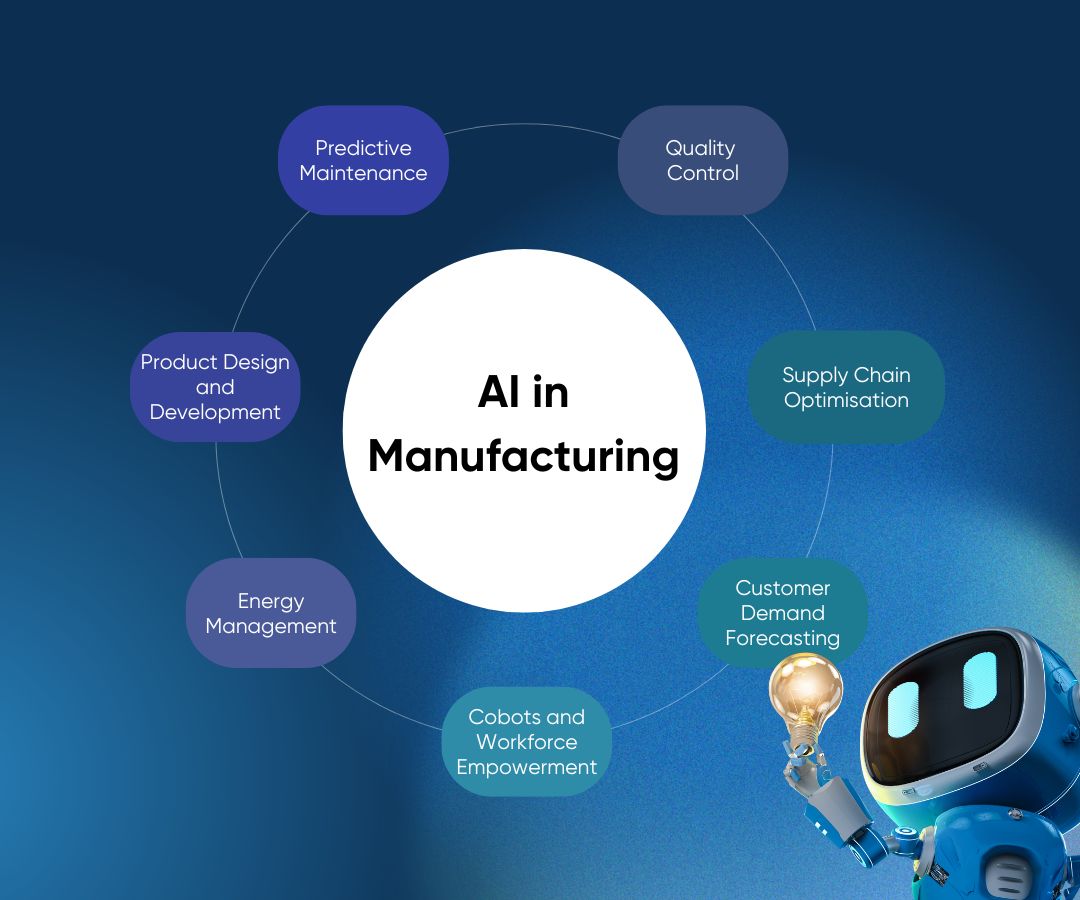
AI in manufacturing marks a fundamental shift from static, rule-based automation to intelligent, adaptive systems. By leveraging technologies such as machine learning, computer vision, and edge AI, manufacturers can improve efficiency, quality, and resilience in an increasingly competitive environment.
At Havi Technology, we see the most successful manufacturers approach AI as a long-term capability rather than a one-off project. By aligning AI initiatives with business objectives, investing in data and people, and scaling responsibly, organizations can build truly smart factories powered by AI—and position themselves for sustainable growth in the years ahead.