Odoo AI Agents vs Traditional Automation: What’s the Difference?

image

Havi Technology

Author
Dec 18, 2025
|
Havi Technology

Enterprise automation has existed for decades, long before artificial intelligence became mainstream. ERP systems like Odoo have always supported automation through rules, workflows, and triggers designed to reduce manual work and enforce consistency. However, as business environments grow more complex and data-driven, traditional automation alone is no longer sufficient.

This gap has led to the rise of Odoo AI agents—intelligent, context-aware components that extend automation beyond fixed logic into adaptive, decision-supporting workflows. For organizations researching Odoo AI, one of the most important questions is not whether AI exists in Odoo, but how AI agents fundamentally differ from traditional automation and when each approach should be used.

This article provides a deep, structured comparison between Odoo AI agents and traditional automation, covering architecture, capabilities, use cases, risks, and business value. By the end, you will clearly understand how these two approaches differ, how they complement each other, and why AI agents represent the next phase of ERP automation.

1. Understanding Traditional Automation in Odoo

1.1 What Is Traditional Automation?

Traditional automation in Odoo refers to rule-based mechanisms that execute predefined actions when specific conditions are met. These automations are deterministic, meaning the same input always produces the same output.

Common examples include:

  • Automatically confirming a sales order when payment is received
  • Sending an email when an invoice becomes overdue
  • Updating a record status when a workflow stage changes
  • Creating tasks based on predefined triggers

These automations are predictable, reliable, and easy to audit.

1.2 Core Components of Traditional Odoo Automation

Traditional automation typically relies on:

  • Automated Actions (server actions)
  • Scheduled Actions (cron jobs)
  • Workflow rules
  • Conditional logic based on record fields

The logic is explicitly defined by humans and does not change unless reconfigured.

1.3 Strengths of Traditional Automation

Traditional automation remains essential because it offers:

  • High reliability and consistency
  • Clear cause-and-effect relationships
  • Strong compliance and auditability
  • Low computational and operational cost

For repetitive, well-defined processes, traditional automation is often the best solution.

2. Introducing Odoo AI Agents

2.1 What Are Odoo AI Agents?

Odoo AI agents are AI-powered components embedded within the Odoo ERP that can analyze data, understand context, generate insights or content, and assist or act within workflows.

Unlike traditional automation, AI agents are not limited to predefined logic. They can:

  • Interpret natural language
  • Analyze patterns across historical data
  • Generate flexible outputs
  • Adapt recommendations based on context

They operate as intelligent co-pilots rather than rigid executors.

2.2 The Core Idea Behind AI Agents

AI agents shift automation from:

  • “Do exactly this when X happens”
    to
  • “Given this context, what is the best next action?”

This distinction is central to understanding their value.

2.3 Why AI Agents Are Emerging Now

AI agents have become viable due to:

  • Advances in large language models
  • Improved data availability within ERP systems
  • Better integration between AI services and business applications
  • Growing demand for decision support, not just execution

Odoo AI agents reflect this broader technological shift.

3. Architectural Differences: Rules vs Intelligence

3.1 Traditional Automation Architecture

Traditional automation architecture consists of:

  • A trigger (event or schedule)
  • A condition (logical check)
  • A predefined action

The system does not reason; it only evaluates conditions.

3.2 AI Agent Architecture

Odoo AI agents introduce additional layers:

  • Context awareness (record, user, workflow state)
  • AI inference (predictive or generative models)
  • Recommendation or generation logic
  • Governance and approval controls

This architecture allows agents to reason probabilistically rather than deterministically.

3.3 Deterministic vs Probabilistic Behavior

Traditional automation is deterministic:

  • Same input → same output

AI agents are probabilistic:

  • Similar input → potentially different, contextually optimized output

This flexibility enables intelligence but requires governance.

4. Capability Comparison: What Each Approach Can Do

4.1 Data Handling

Traditional automation:

  • Works best with structured data
  • Relies on explicit field values

AI agents:

  • Handle structured and unstructured data
  • Interpret text, documents, and context

4.2 Decision-Making

Traditional automation:

  • Executes predefined decisions

AI agents:

  • Support decision-making by evaluating patterns, probabilities, and context

4.3 Content Creation

Traditional automation:

  • Uses templates with static placeholders

AI agents:

  • Generate dynamic content tailored to the situation

4.4 Adaptability

Traditional automation:

  • Requires manual reconfiguration to change behavior

AI agents:

  • Adapt outputs based on new data and context

5. Odoo AI Agents vs Traditional Automation in Real Use Cases

5.1 Sales and CRM

Traditional automation:

  • Assign leads based on fixed rules
  • Send predefined follow-up emails

AI agents:

  • Score leads dynamically
  • Recommend personalized next actions
  • Draft customized emails based on customer history

5.2 Marketing and Content

Traditional automation:

  • Schedule campaigns
  • Send templated messages

AI agents:

  • Generate campaign copy
  • Adapt messaging for different audiences
  • Optimize content based on performance signals

5.3 Accounting and Finance

Traditional automation:

  • Validate transactions against rules
  • Trigger reminders for overdue invoices

AI agents:

  • Detect anomalies
  • Forecast cash flow
  • Summarize financial performance

5.4 Inventory and Supply Chain

Traditional automation:

  • Reorder products when stock falls below a threshold

AI agents:

  • Forecast demand patterns
  • Recommend optimal reorder quantities
  • Identify slow-moving stock risks

5.5 Customer Support

Traditional automation:

  • Route tickets based on categories
  • Send canned responses

AI agents:

  • Summarize conversations
  • Suggest context-aware replies
  • Prioritize tickets based on sentiment and urgency

6. Human Interaction and Control

6.1 Human Role in Traditional Automation

Humans:

  • Design the rules
  • Monitor outcomes
  • Adjust logic when needed

Once configured, the system runs independently.

6.2 Human Role in AI Agent Workflows

With AI agents, humans:

  • Define boundaries and intent
  • Review recommendations
  • Approve or override actions
  • Continuously refine prompts and policies

This creates a human-in-the-loop model.

6.3 Trust and Accountability

Traditional automation:

  • Easy to audit and explain

AI agents:

  • Require transparency, logging, and explainability to maintain trust

7. Governance, Risk, and Compliance

7.1 Risk Profile of Traditional Automation

Risks are typically:

  • Logic errors
  • Incomplete rule coverage

These risks are predictable and manageable.

7.2 Risk Profile of AI Agents

AI agents introduce new risks:

  • Inaccurate or hallucinated outputs
  • Over-automation
  • Data privacy concerns

7.3 Governance Best Practices

Effective governance includes:

  • Approval workflows for critical actions
  • Clear usage policies
  • Output logging and auditing
  • Regular performance reviews

Responsible AI use is essential.

8. Business Value Comparison

8.1 Efficiency Gains

Traditional automation:

  • Reduces repetitive manual work

AI agents:

  • Reduce cognitive and analytical workload

8.2 Scalability

Traditional automation:

  • Scales processes

AI agents:

  • Scale expertise and judgment

8.3 Strategic Impact

Traditional automation:

  • Improves operational efficiency

AI agents:

  • Improve decision quality and responsiveness

The value of AI agents compounds over time as data quality improves.

9. When to Use Traditional Automation, AI Agents, or Both

9.1 Best Use Cases for Traditional Automation

  • Compliance-driven processes
  • Financial controls
  • Simple, repetitive tasks
  • Scenarios requiring strict predictability

9.2 Best Use Cases for Odoo AI Agents

  • Decision support
  • Content generation
  • Forecasting and prioritization
  • Situations involving ambiguity or complexity

9.3 Hybrid Automation Models

The most effective Odoo implementations combine both:

  • Traditional automation for execution
  • AI agents for intelligence and assistance

This hybrid approach delivers the best balance of control and flexibility.

10. Strategic Outlook: Why AI Agents Are the Next Evolution of Automation

Traditional automation will not disappear. Instead, it will serve as the execution backbone of ERP systems, while AI agents provide the intelligence layer that guides decisions and adapts workflows.

For organizations investing in Odoo AI, understanding this distinction is critical. AI agents are not replacements for traditional automation—they are enhancements that unlock new levels of efficiency, insight, and scalability.

Frequently Asked Questions

Are Odoo AI agents more expensive than traditional automation?

They can be, depending on usage and AI services, but they often deliver higher strategic value.

Can AI agents fully replace rule-based automation?

No. Rule-based automation remains essential for predictable and compliant processes.

Do AI agents require more governance?

Yes. Responsible implementation requires oversight, logging, and approval mechanisms.

Is traditional automation becoming obsolete?

No. It remains foundational, while AI agents extend its capabilities.
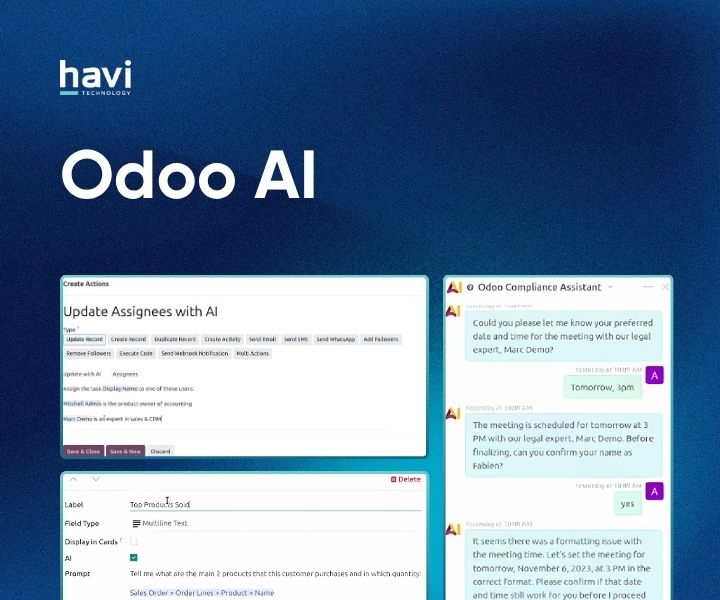
Control vs Intelligence—Finding the Right Balance

The difference between Odoo AI agents and traditional automation is not about superiority—it is about purpose. Traditional automation excels at executing known rules reliably. Odoo AI agents excel at navigating uncertainty, interpreting context, and supporting human decisions.

Organizations that understand this distinction—and design their ERP strategy accordingly—gain the best of both worlds: control where it matters most, and intelligence where it delivers the greatest value. In this balance lies the future of ERP automation and the true promise of Odoo AI.