


When businesses decide to implement Odoo ERP, one of the most important—and most misunderstood—decisions is who should implement and manage the system. Should you hire an independent Odoo Consultant, work with an official Odoo Partner, or build an in-house Odoo team?
There is no universally “correct” answer. The right choice depends on your business size, complexity, growth plans, internal capabilities, and risk tolerance. However, choosing the wrong model can lead to ERP failure, wasted budget, and long-term operational pain.
This article provides a clear, decision-oriented comparison of Odoo Consultant vs Odoo Partner vs In-House Team, focusing on roles, strengths, limitations, costs, and real-world use cases. The goal is to help you choose the engagement model that delivers ERP success, not just system go-live.
Drawing on ERP best practices and implementation approaches used by experienced providers such as Havi Technology, this guide emphasizes long-term value, scalability, and governance over short-term convenience.
Odoo is not a simple application—it is an ERP platform that becomes the backbone of your business. It controls:
Because ERP systems sit at the center of operations, implementation decisions shape how your business works for years.
Many ERP projects fail not because of bad software, but because:
Choosing between an Odoo Consultant, an Odoo Partner, or an In-House Team is therefore a strategic decision, not a procurement detail.
Before comparing them, it’s important to clearly define each model.
An Odoo Consultant is an individual specialist (or small consulting unit) who helps businesses analyze requirements, configure Odoo, guide implementation, and optimize workflows.
They typically focus on:
Odoo consultants may be functional, technical, or techno-functional.
An Odoo Partner is an officially recognized company approved by Odoo to deliver implementation, customization, and support services.
Odoo partners usually provide:
Partners range from small regional firms to large global system integrators.
An In-House Odoo Team consists of employees within your organization responsible for:
This model requires internal ERP expertise and long-term investment in people.
Understanding responsibility boundaries helps clarify which model fits your needs.
If deep process transformation is required early, external expertise is critical.
Customization governance is strongest when supported by mature ERP methodology.
For large or high-risk projects, governance maturity is essential.
An independent Odoo Consultant can be the right choice in many scenarios.
Consultants typically:
This is attractive for startups and SMEs with limited budgets.
You work directly with the consultant who:
There is minimal communication loss compared to larger teams.
Odoo consultants can:
This is ideal for focused or phased implementations.
However, consultants also have constraints:
This risk increases as project complexity grows.
An Odoo Partner is often the safest option for complex ERP initiatives.
Partners offer:
This allows parallel workstreams and faster execution at scale.
Odoo partners typically follow:
Firms like Havi Technology emphasize this structure to reduce ERP risk and ensure long-term scalability.
Partners can provide:
This is critical for mission-critical ERP systems.
Despite their strengths, partners may not be ideal for every business:
Choosing the right partner is still essential.
An In-House Team can be a strategic advantage for certain organizations.
Internal teams:
This leads to faster day-to-day optimization.
For organizations with heavy ERP usage:
This model suits mature organizations with stable processes.
In-house teams enable:
ERP becomes a strategic asset rather than a vendor-managed system.
However, building an in-house team is not trivial:
Many ERP failures occur when in-house teams lack external guidance.
Cost is often the deciding factor—but it must be evaluated correctly.
Total cost of ownership matters more than initial price.
ERP risk should be a primary evaluation factor.
Best fit:
Focus: Speed, cost control, basic automation.
Best fit:
Focus: Process standardization, scalability, reporting.
Best fit:
Focus: Governance, compliance, long-term ERP strategy.
Many successful Odoo implementations use a hybrid approach:
This model combines:
At Havi Technology, hybrid engagement models are commonly recommended to balance risk, cost, and scalability.
Regardless of the model, avoid these warning signs:
These issues cause ERP failure across all models.
Not always. For small, focused projects, a skilled consultant may deliver better value.
Yes, this is a common and effective progression.
Often yes—for audits, upgrades, and strategic guidance.
Partners generally reduce risk for complex projects, but quality matters more than labels.
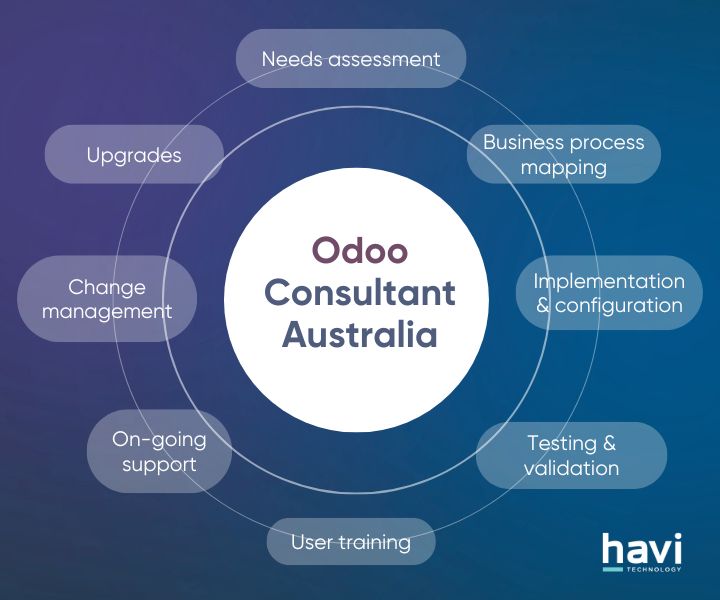
Choosing between an Odoo Consultant, an Odoo Partner, or an In-House Team is not about prestige or price—it is about fit.
The right choice depends on:
What matters most is not who implements Odoo, but how well they align the system with your business reality.
By understanding the strengths, limitations, costs, and risks of each model—and by applying disciplined ERP practices like those used by Havi Technology—you can choose an approach that delivers sustainable ERP success, not just a working system.
In Odoo projects, the implementation model you choose today will shape how your business operates tomorrow.