


When organizations research odoo pricing, they are often focused on a single figure: the subscription price per user. While that number is important, it represents only a fraction of what businesses actually pay over the lifetime of an ERP system.
The more strategic—and financially responsible—question is this:
What is the total cost of ownership (TCO) of Odoo over 3, 5, or even 10 years?
Odoo is widely recognized for its flexibility, modular architecture, and competitive pricing compared to traditional ERP systems. However, like any enterprise platform, its true cost depends on far more than licensing alone. Hosting, implementation, customization, integrations, upgrades, support, and internal change management all shape the real financial impact.
In this comprehensive guide, Havi Technology breaks down Odoo pricing through the lens of total cost of ownership, helping business leaders understand what they will really spend—and why. This article is written for CFOs, founders, CIOs, operations managers, and ERP decision-makers who need clarity, not marketing headlines.
By the end of this guide, you will understand:
Odoo pricing cannot be evaluated accurately without understanding total cost of ownership (TCO). TCO represents the full cost of an ERP system over its useful life—not just what you pay in the first year.
For Odoo, TCO typically includes:
Many organizations underestimate ERP costs by focusing only on visible subscription fees. In practice, implementation and post-go-live costs often outweigh licensing costs, particularly for businesses with complex operations.
At Havi Technology, we consistently advise clients to evaluate Odoo pricing across a minimum three- to five-year horizon. This approach aligns technology investment with business growth and reduces financial surprises.
To calculate Odoo’s total cost of ownership, you must first understand its core pricing model.
Odoo Enterprise is licensed on a per internal user basis. Every employee who accesses the system for operational purposes requires a paid license.
Important considerations:
While per-user pricing provides predictability, uncontrolled user growth can inflate long-term costs.
Odoo’s subscription fee covers:
However, it does not cover:
These elements form a significant part of Odoo’s TCO and are usually delivered by implementation partners like Havi Technology.
Odoo typically promotes annual billing, which:
From a TCO perspective, annual billing helps stabilize long-term ERP expenditure.
Odoo is available in two main editions, each with distinct TCO implications.
Odoo Community Edition is:
While there is no subscription cost, Community Edition still requires investment in:
Over time, these costs accumulate. Community Edition often has:
Community Edition is best suited for organizations with strong in-house technical teams and narrowly defined requirements.
Odoo Enterprise includes:
Enterprise reduces TCO risk by:
For most SMEs and enterprises, Enterprise delivers lower long-term TCO, despite higher upfront licensing costs.
While Community may appear cheaper initially, Enterprise often proves more cost-effective over time due to:
This trade-off is a critical part of Odoo pricing strategy, and one that Havi Technology evaluates carefully with each client.
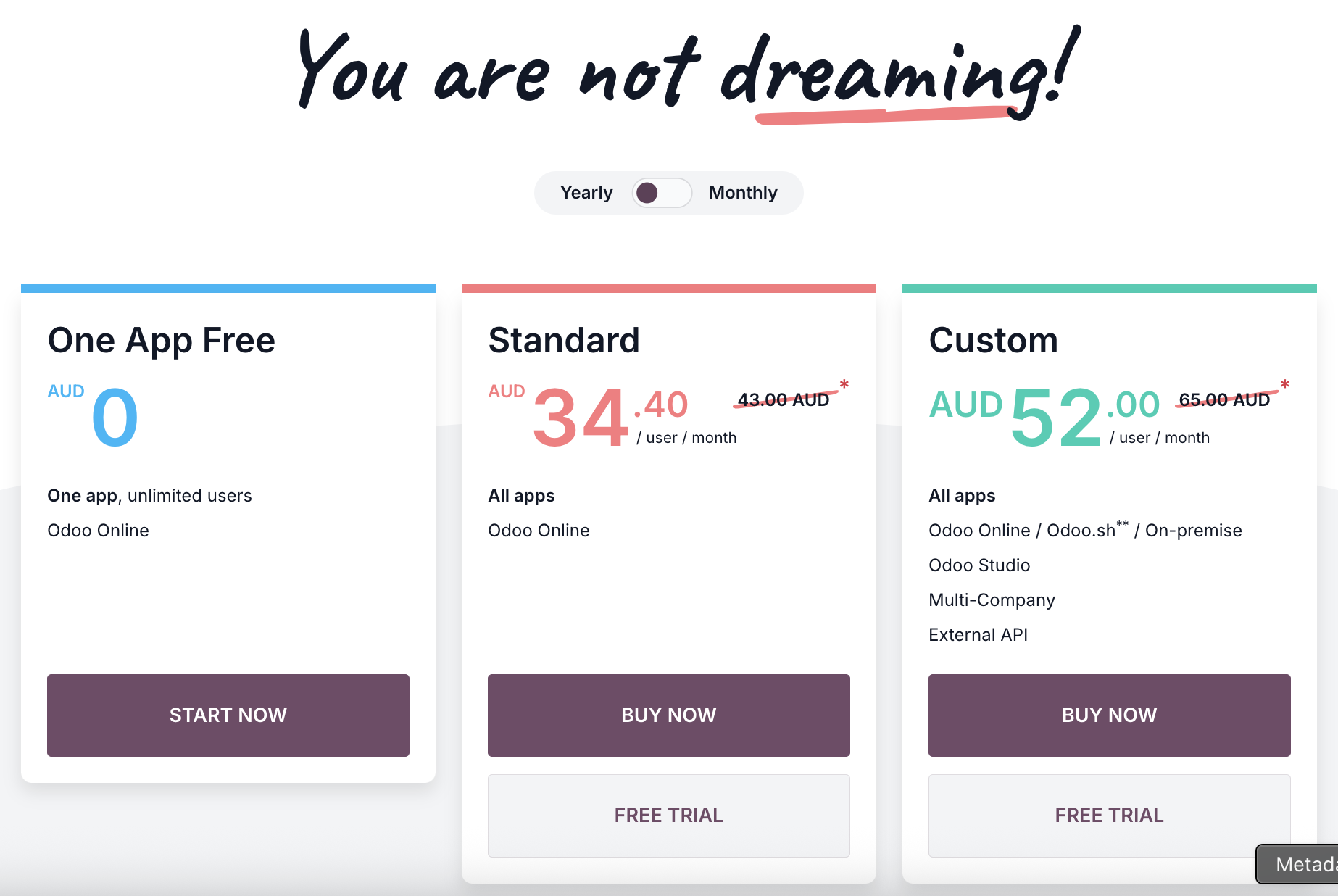
Odoo Enterprise pricing is structured around three primary plans, each affecting total cost differently.
The One App Free plan offers:
This plan has minimal direct cost but limited long-term scalability. It is best suited for:
From a TCO perspective, it is not designed for full ERP adoption.
The Standard plan includes:
This plan provides:
It is ideal for organizations with standardized processes and limited customization needs.
The Custom plan offers:
While this plan has higher initial costs, it often delivers better long-term value for complex organizations by enabling:
Hosting plays a major role in Odoo’s total cost of ownership.
Odoo Online is:
It offers the lowest infrastructure cost but limited flexibility.
Odoo.sh provides:
Costs scale based on:
Odoo.sh balances flexibility and operational efficiency and is commonly used in partner-led projects with Havi Technology.
On-premise hosting offers:
But increases TCO through:
Implementation is typically the largest single component of Odoo’s total cost of ownership.
A complete implementation covers:
Typical implementation cost ranges include:
Well-designed implementations reduce TCO by:
Poor implementations increase long-term support and maintenance costs.
Customization can either enhance value or significantly inflate TCO.
Third-party apps can:
Integrations with accounting, e-commerce, logistics, or BI tools add:
Each integration must be evaluated for long-term value.
Odoo’s TCO continues after implementation.
Ongoing support includes:
Annual upgrades require:
As organizations grow:
Lowest overall TCO.
Balanced cost-to-value ratio.
Highest TCO but maximum scalability and control.
Avoiding these mistakes significantly improves ROI.
Odoo delivers strong long-term value when:
It may not be ideal if:
Odoo pricing is best understood through the lens of total cost of ownership, not just subscription costs. When evaluated correctly, Odoo can be one of the most cost-effective ERP platforms available.
However, long-term success depends on:
At Havi Technology, we help businesses evaluate, implement, and optimize Odoo with a clear focus on long-term value—not just short-term cost savings. Understanding Odoo pricing and TCO is the first step toward making ERP a competitive advantage rather than a financial burden.